In ancient times, cultures celebrated warriors, explorers, and creators whose excellence was visible and costly. Greek myth gave us Hercules and Orpheus. History recorded figures like Leonardo da Vinci, Paganini, Boudica, Davy Crockett, Judith of Bethulia, Eric the Red, Sir William Marshal, Robert the Bruce, William the Conqueror, and Joan of Arc. These men and women were athletic, intelligent, brave, or inventive in ways that shaped the lands they lived in and impressed even their enemies. Their stories traveled because the traits they embodied, grit, delayed gratification, courage, and loyalty to something larger than the self, were scarce and consequential.
That same human capacity never disappeared, and it was never limited by sex or culture. Women displayed it as fully as men. Boudica raised the Iceni in revolt against Rome after personal and national humiliation. Joan of Arc, a teenage peasant, imposed discipline on demoralized troops and altered the course of the Hundred Years’ War. Anne of Kiev left her homeland, married into the French royal house, served as regent for her young son, signed charters in her own hand, and left a measurable imprint on a foreign court. In the biblical tradition, Judith of Bethulia walked into the camp of the Assyrian general Holofernes, won his trust, and beheaded him as he slept, saving her people from conquest. Across the globe the pattern repeats: Tomoe Gozen on the battlefields of Japan, the Trung sisters resisting Chinese rule in Vietnam, African queens and warriors who defended their kingdoms, Indigenous leaders of both sexes who fought or negotiated for their peoples’ survival. The virtues themselves were never the private property of one sex or one civilization. Cultures often trained them more systematically in men because of physical differences and the division of high-risk labor, but history records them wherever circumstances demanded them and individuals proved equal to the demand.
Today the cultural spotlight has shifted. Extreme-sports athletes still risk life and limb, and elite soldiers, explorers, and builders still exist. Yet mainstream attention is largely captured by internet influencers, actors, and musicians filtered through institutional and algorithmic gatekeepers. The older heroic archetype has not vanished; it has been crowded to the margins. In its place sits a softer, more accessible form of status, one that rewards consistency of appearance, emotional relatability, and the ability to hold attention in a deeply saturated information environment.
This change accompanies a deeper paradox. We possess more specialized knowledge and material abundance than any previous civilization, yet many of the classical virtues appear to be faded in the distance, if not in full retreat. Grit, stoicism, ambition, and self-transcending loyalty are too often pathologized, especially when displayed by men, under the elastic label “toxic masculinity.” What began as a critique of genuine excesses, violence, emotional repression that harms, dominance for its own sake, has expanded until it frequently lands on the very dispositions that enable long-term growth and collective survival. The result is a moral inversion: traits that once helped individuals and societies endure hardship are treated as suspect, precisely when hardship feels remote.
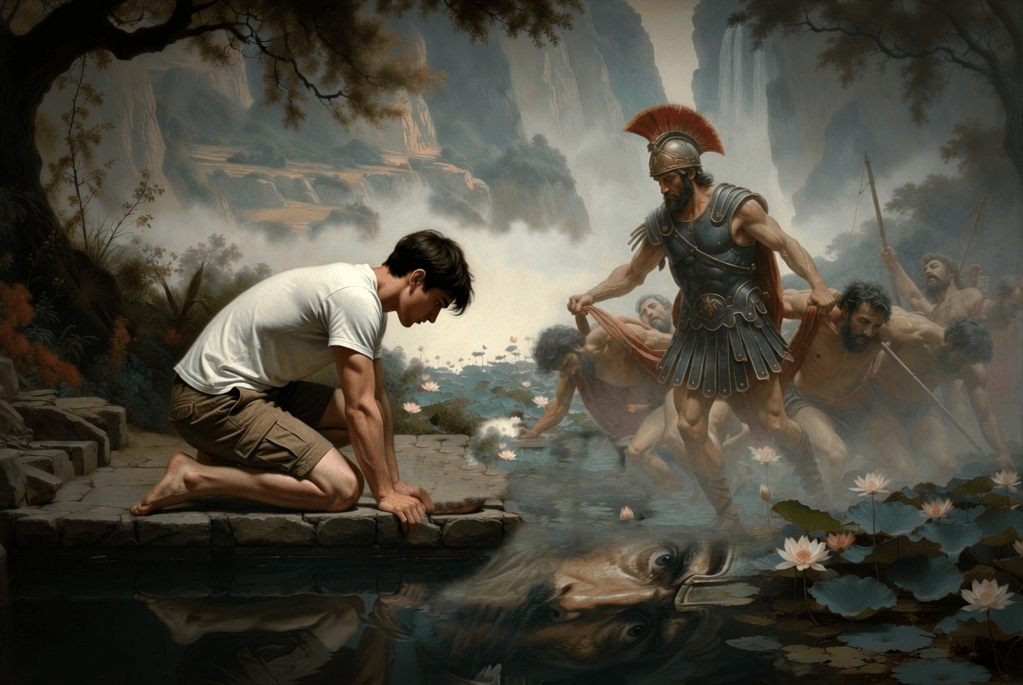
The ancient story that best captures this dynamic is the episode of the Lotus-Eaters in Homer’s Odyssey. Odysseus’s crew lands on an island and is offered the lotus fruit. It doesn’t kill or enslave by force. It simply removes the desire; or any inclination at all, to continue the hard voyage home. The men become content to remain in a soft, dreamy present, forgetting their households, their duties, their loyalties, and their future. Odysseus must drag them back to the ships and bind them, because the pleasure of forgetting has become stronger than the call of responsibility. Much like today, where people would rather cancel than deal with reality.
Rabbi Abraham Twerski’s well-known parable of the lobster offers a complementary image from biology. A lobster is soft tissue confined inside a rigid shell that cannot expand. As the animal grows, the shell becomes constricting and uncomfortable. Only then does the lobster retreat under a rock, shed the old shell, and grow a new, larger one. The stimulus for growth is the pressure itself. Twerski noted that if lobsters could consult physicians, they would receive sedatives or painkillers, feel immediate relief, and never grow again. Stress, properly used, is not merely an affliction; it is the signal and the condition for growth and empowerment.
Modern comforts function in much the same way as both the lotus and the hypothetical lobster tranquilizer. Endless entertainment, pharmacological and digital buffers against discomfort, and ideological frameworks that reframe struggle, hierarchy, or even basic biological realities as forms of oppression act as a collective anesthetic. People are not conquered; they stop wanting to leave the island or to endure the tight shell. In a high-surplus environment the cost of pathologizing resilience and excellence feels low, until the environment changes and those capacities are suddenly required again.
Abundance has always carried this risk. Rome at its material peak produced moralists who complained of luxury and the softening of civic and martial character. Knowledge is cumulative; virtue isn’t. Technical mastery can race ahead of the cultural habits that produce toughness, restraint, and loyalty. The current ideological fashion amplifies the soft spots, but it is not the sole cause. Atomization, family breakdown, and the sheer volume of low-stakes stimulation all play their parts.
The older virtues still exist, in special-operations units, competitive subcultures, certain religious and classical educational pockets, and in ordinary people who simply refuse the fruit. Excellence doesn’t change its nature according to the sex of the person who shows it, nor does it become toxic merely because it is demanding. Cultures that systematically discourage grit, courage, and loyalty beyond the self are not expanding the range of human possibility; they are narrowing it.
The question the story leaves us with is the same one Odysseus faced: Once a large enough portion of the crew has tasted the fruit and no longer wants to row, how do you get the ship moving again?