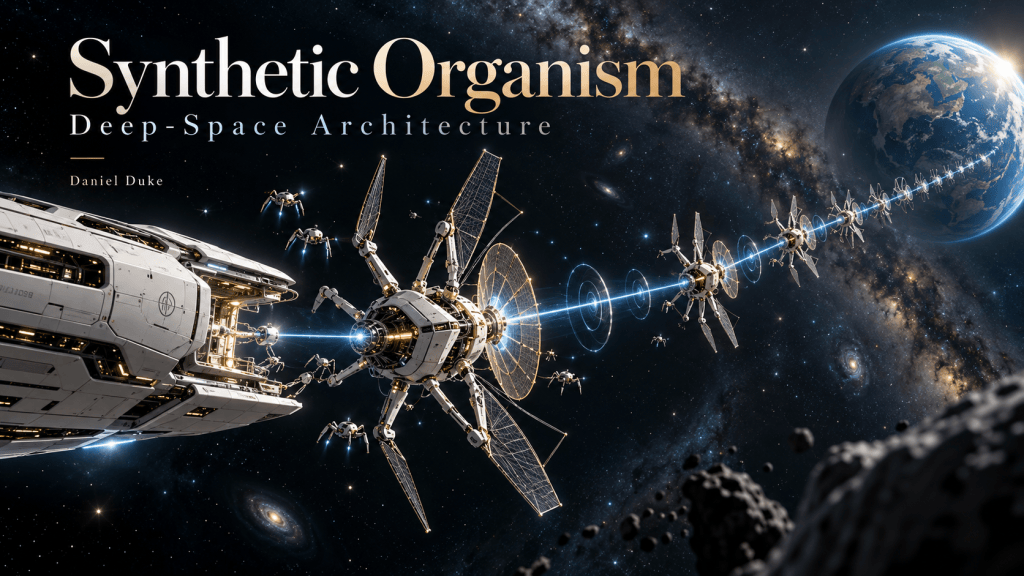
Daniel Duke · October 2026 · Version 0.1 / 0.3
Licensed under CC BY 4.0
I developed this concept as an open architecture for others to study, improve, test, and build upon. I am releasing it freely under CC BY 4.0 in the hope that someone with the right expertise and resources may find it useful.
Synthetic Organism Deep-Space Architecture
Public Executive Summary
Daniel Duke
Version 0.1 | October 11, 2026
Open concept paper — Architecture for discussion, research, refinement, and implementation.
The Idea in One Sentence
| Build orbital and deep-space infrastructure like a living system: distributed intelligence, nested maintenance swarms, self-repair, graceful failure recovery, and infrastructure that accumulates as exploration moves outward. |
Why This Architecture
Space systems are expensive to reach and difficult to repair. The farther they travel from Earth, the less practical it becomes to depend on human intervention, continuous ground control, or a single irreplaceable spacecraft. The Synthetic Organism (S.O.) concept addresses that problem by treating maintenance, communications, science, computing, and logistics as one integrated ecology rather than separate missions.
Architecture at a Glance
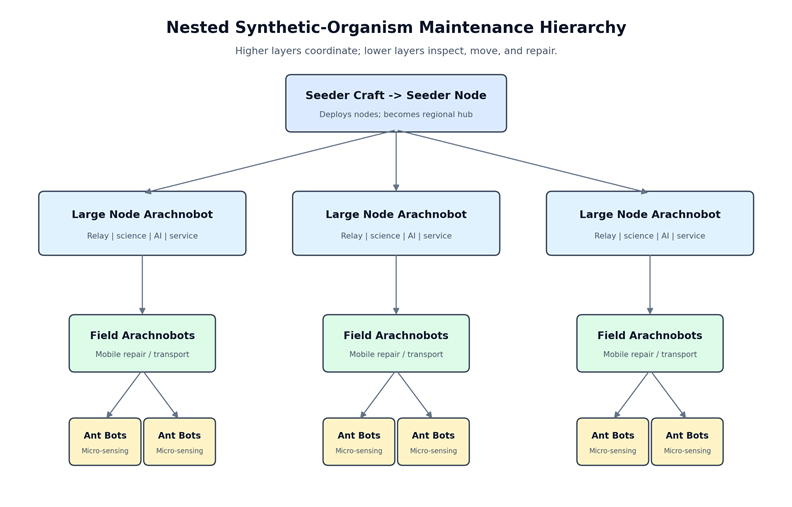
Nested robotic hierarchy: each layer carries, coordinates, and helps maintain the layer below it.
- Seeder Craft – carries tightly folded large node-class Arachnobots along a route, deploys them one by one, then converts into a permanent high-capacity Seeder Node.
- Seeder Node – regional AI data center, science hub, archive, communications relay, fabrication/repair depot, and preferred coordinator.
- Large Node Arachnobots – multifunction spacecraft that combine communications, telescopes, sensors, local AI, power, recharge/service bays, and mobile repair colonies.
- Field Arachnobots – smaller multi-limbed robots that inspect, repair, transport parts, and service neighboring hardware.
- Ant Bots – small inspection and micro-repair swarms controlled by parent Arachnobots; the distributed “workers” or immune cells of the system.
- Backup leadership – surrounding nodes can assume critical regional functions if the Seeder Node fails, preserving continuity of intelligence and communications.
The Interstellar Corridor
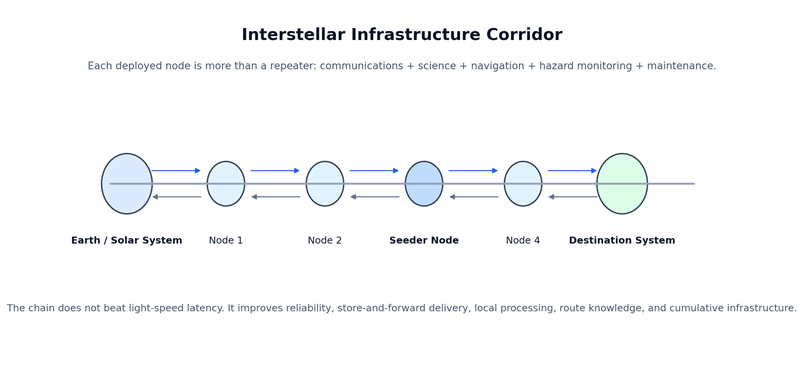
The route becomes cumulative infrastructure: communications, science, navigation, hazard monitoring, and maintenance.
Every node is more than a relay. It monitors radiation, dust, objects, system health, and the changing astronomical environment; hosts telescopes and sensors; supports navigation; and maintains nearby infrastructure. Later missions can add denser nodes and upgrade older ones. The network cannot beat the speed of light, but it can improve store-and-forward reliability, local processing, redundancy, route knowledge, and the amount of useful infrastructure available to later travelers.
What Exists Already
The full system does not exist, but important building blocks do. NASA’s Distributed Spacecraft Autonomy work has demonstrated multi-spacecraft decision-making and workload redistribution. NASA’s AstroAnts project studies small robot swarms for inspection, assembly, repairs, and maintenance. NASA’s Delay/Disruption Tolerant Networking is an operational foundation for a Solar System Internet. DARPA is developing dexterous robotic satellite servicing. NASA also studied self-replicating systems and advanced automation decades ago. The S.O. concept is therefore best understood as an integration architecture, not a claim that every component is new.
What Remains Hard
- Propulsion and precise deployment of nodes along a deep-space or interstellar route.
- Long-lived power far from the Sun, where solar energy becomes weak.
- Thermal management, radiation tolerance, and decades-long mechanical reliability.
- Verified autonomy that can make local decisions without becoming a single opaque failure mode.
- Onboard fabrication and recycling, especially the much harder problem of replacing advanced electronics.
- Mass and cost: the system must prove that its extra complexity buys enough longevity, uptime, and mission capability to justify itself.
Long-Term Payoff
A Synthetic Organism explorer could reach a promising Earth-like world decades before humans, study it continuously, prepare communications and navigation infrastructure, map resources and hazards, and send findings home through the corridor. Human travelers would eventually arrive with extensive knowledge not only of the destination planet, but also of the entire route between Earth and their new system.
Open Invitation
| Study it. Improve it. Test it. Build it. |
This concept is offered openly for research, engineering discussion, refinement, and implementation. The biological language is a design metaphor; the engineering functions are what matter. If a future system preserves the nested autonomy, self-maintenance, distributed backup, transformable node architecture, and cumulative route infrastructure without resembling a spider or an ant at all, that is still success.
The objective is simple: put the architecture into the world so that people with the tools, laboratories, spacecraft, funding, and expertise to test it can decide whether any part of it is worth building.
Selected Technical References
[1] NASA Ames Research Center. What is NASA’s Distributed Spacecraft Autonomy?. 2025. https://www.nasa.gov/centers-and-facilities/ames/what-is-nasas-distributed-spacecraft-autonomy/
[2] NASA TechPort. Autonomous Robot Swarms for Lunar Orbit Servicing and Space Asset Assembly (AstroAnts). updated 2026. https://techport.nasa.gov/projects/106703
[3] NASA. Delay/Disruption Tolerant Networking. operational update 2026. https://www.nasa.gov/communicating-with-missions/delay-disruption-tolerant-networking/
[4] DARPA. Robotic Servicing of Geosynchronous Satellites technology to launch in 2026. 2026. https://www.darpa.mil/news/2026/robotic-servicing-geosynchronous-satellites-technology-launch-2026
[5] NASA Technical Reports Server. Self-replicating systems: A systems engineering approach. 1980. https://ntrs.nasa.gov/citations/19800025701
Synthetic Organism Deep-Space Architecture
A hierarchical, self-maintaining architecture for orbital and interstellar infrastructure
Daniel Duke
Version 0.1 | October 11, 2026
Open concept paper – Architecture for discussion, research, refinement, and implementation.
Document Status and Intent
This paper preserves a systems concept developed through an October 2026 design conversation. It is an architecture proposal, not a finished engineering design, mission authorization, patent opinion, safety certification, or claim that every subsystem is novel.
| Core proposition: Do not build space infrastructure that merely waits to be repaired. Build infrastructure that continuously senses, maintains, repairs, adapts, and extends itself. |
Several enabling ideas already exist independently in current or historical research: distributed spacecraft autonomy, robotic servicing, small-robot swarms, delay/disruption-tolerant networking, and studies of self-replicating systems. The contribution preserved here is their deliberate integration into a nested “Synthetic Organism” architecture in which transport, computation, communications, science, inspection, repair, redundancy, and long-term growth are designed as one system.
Abstract
The Synthetic Organism (S.O.) architecture treats a long-duration orbital or deep-space system as an engineered organism rather than a collection of isolated spacecraft. It consumes energy, processes information, rejects waste heat, senses internal and external conditions, maintains homeostasis, repairs damage, reallocates work after failures, and can be designed to adapt or eventually reproduce infrastructure. A transformable Seeder Craft deploys large node-class Arachnobots along a route and then becomes a high-capacity Seeder Node containing AI compute, science instruments, storage, fabrication support, and communications. Each large node can contain smaller Field Arachnobots, and each Field Arachnobot can carry colonies of tiny Ant Bots for inspection, sensing, and micro-repair. The result is a nested, cellular maintenance ecology with no intentional single point of failure.
For interstellar missions, the same architecture can leave behind a chain of multifunction nodes that form a persistent communications, navigation, science, hazard-monitoring, and maintenance corridor. The corridor cannot reduce the speed-of-light delay to Earth, but it can improve reliability, local processing, route knowledge, cumulative observation, redundancy, and infrastructure available to later missions. In the long term, such a system could survey and prepare a destination system decades before human arrival.
1. Design Philosophy: A Machine That Behaves Like an Organism
The term “Synthetic Organism” is intentionally architectural rather than biological. The system need not be declared “alive” to benefit from biological design principles. Its value comes from homeostasis, specialization, redundancy, nested repair, energy management, adaptation, and distributed intelligence.
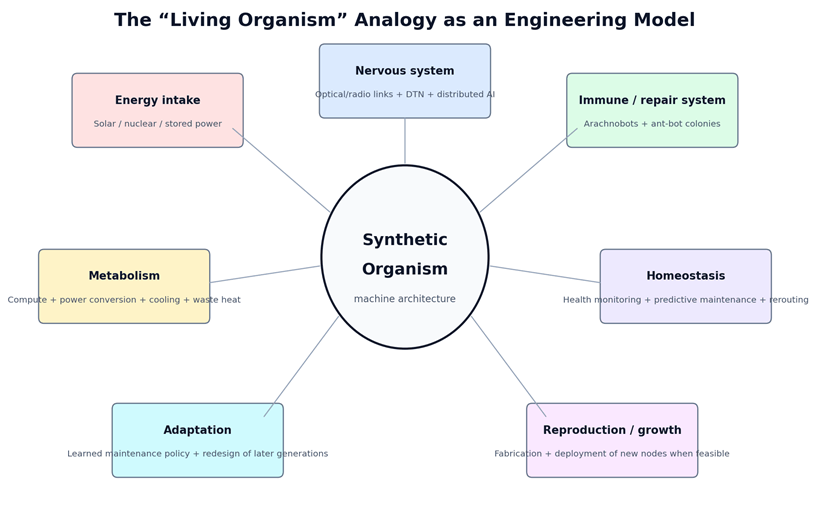
Figure 1. The “living organism” analogy is used as an engineering model, not as a biological classification.
At minimum, the system should be able to detect degradation before failure, localize the problem, assign the smallest capable maintenance unit, continue operating around the fault where possible, repair or replace damaged components, verify the repair, and update future maintenance decisions from the experience.
In later generations, adaptation could extend from operating policy to physical redesign. A repeated failure mode could cause the system to alter inspection intervals, choose different materials, revise component geometry, or propagate an improved module design into later nodes. If a sufficiently advanced system can also fabricate and deploy new infrastructure from stored or acquired materials, the analogy approaches growth and reproduction in a systems-engineering sense.
2. System Hierarchy
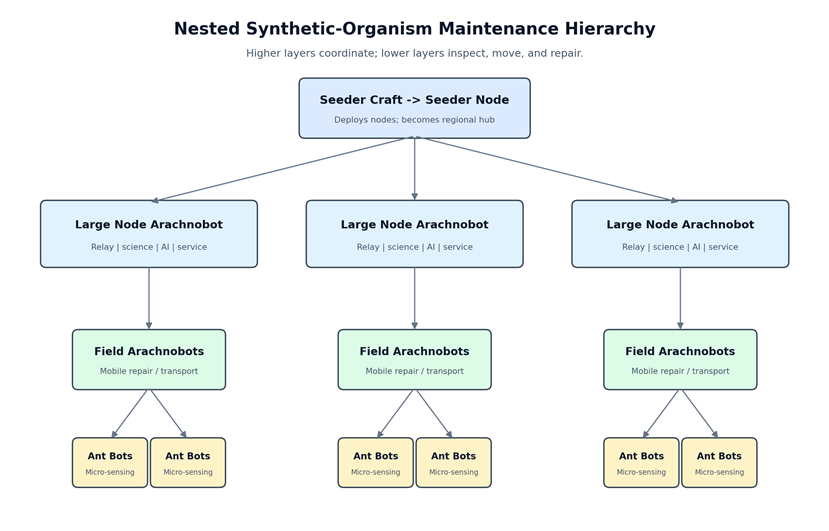
Figure 2. Nested maintenance hierarchy: large nodes contain mobile service units; mobile service units contain micro-swarms.
2.1 Seeder Craft
The Seeder Craft is a specialized deployment vehicle rather than the main exploration ship. Its primary mission is to transport tightly packaged node-class Arachnobots along a planned corridor and release them one at a time into designated operational positions. Separation alone is insufficient to create useful spacing, so the Seeder Craft, the deployed node, or both require propulsion and navigation authority to establish the desired trajectory and relative geometry.
After completing the deployment phase, the Seeder Craft is not discarded or automatically returned to Earth. It transforms into the largest persistent node in its region: the Seeder Node.
2.2 Seeder Node: Regional Brain and Scientific Hub
The transformed Seeder Node retains the strongest power, communications, compute, storage, propulsion, and fabrication capability in the local network. It acts as a regional AI data center, science institution, archive, maintenance depot, and communications hub. Smaller nodes forward selected data to it for correlation, analysis, prioritization, compression, and long-term storage before transmission toward Earth.
The Seeder Node is a preferred coordinator, not a mandatory single point of failure. Neighboring large nodes retain enough compute, storage, autonomy, and routing capability to assume critical functions if the Seeder Node is damaged or lost. Recovery therefore produces graceful degradation rather than total regional failure.
2.3 Large Node-Class Arachnobots
A large node-class Arachnobot is simultaneously a spacecraft, relay, observatory, sensor station, maintenance colony, and local compute node. It is packaged compactly for transport, then unfolds after deployment. Its limbs need not resemble terrestrial spider legs literally; they are multi-purpose manipulators, structural booms, anchors, instrument supports, docking interfaces, and repair arms.
A node may host optical and radio communications, telescopes, radiation and particle sensors, magnetometers, dust/impact sensors, navigation references, thermal and structural health monitoring, local AI, storage, and docking/recharge ports. Mission-specific nodes could specialize while retaining a common service interface.
2.4 Field Arachnobots
Large nodes carry smaller Field Arachnobots. These units leave the parent node to inspect, repair, transport parts, service neighboring assets, or reach locations that the node’s fixed manipulators cannot access. The spider-like geometry is attractive because multiple limbs provide redundancy, anchoring, stability, and simultaneous tool use, while the body can fold into a compact launch volume.
A Field Arachnobot should be modular. Limbs, sensors, battery/power modules, tool heads, communications units, and propulsion packs should be replaceable by other robots where practical. A disabled unit can be repaired in place, towed to a service bay, cannibalized for parts, or replaced without endangering the rest of the colony.
2.5 Ant Bots: The Distributed Workforce
Field Arachnobots carry colonies of much smaller Ant Bots. The parent Arachnobot functions as the colony controller or “queen”: it releases the Ant Bots, maintains a map of their locations and health, integrates their sensor reports, validates anomalies across multiple observations, and issues work orders.
Ant Bots are deliberately simpler, cheaper, and more numerous than their parent. Different variants can carry thermal imagers, microscopic cameras, vibration sensors, electrical probes, surface-contact sensors, cleaning tools, sealants, micro-grippers, or marker beacons. They swarm over panels, joints, connectors, radiator edges, structural seams, wiring routes, and other high-risk locations, looking for early signs of failure.
The Ant Bots resemble an immune and maintenance system: they patrol continuously rather than waiting for a major failure. When one unit identifies a problem, nearby units can confirm it, monitor it, or begin a limited repair while the parent Arachnobot decides whether heavier intervention is required.
2.6 Recharge and Service Nests
Permanent infrastructure includes distributed docking and recharge nests. Small Ant-Bot docks provide power, data synchronization, diagnostics, and safe storage. Arachnobot bays provide higher-power charging, tool exchange, replacement parts, self-test, and repair. Major nodes provide deeper maintenance and fabrication capability.
Near the Sun, these systems can draw from solar power and the host power bus. At greater distances, solar intensity declines with the inverse square of distance, so outer-system and interstellar infrastructure would require long-lived nuclear or other high-specific-energy power sources. The architecture is power-source agnostic: the requirement is persistent energy availability, not solar power specifically.
3. Communications and Science Corridor
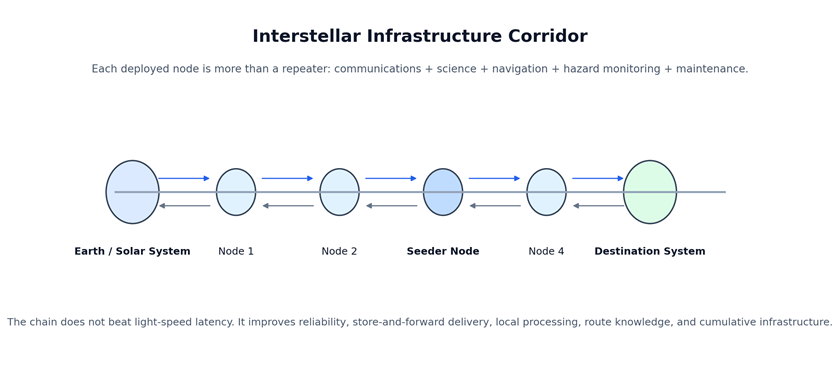
Figure 3. A relay corridor becomes persistent infrastructure rather than disposable “breadcrumbs.”
The route nodes are not simple repeaters. Every deployed large Arachnobot can function as a multi-mission observatory and waypoint. It participates in communications, navigation, scientific observation, hazard monitoring, local maintenance, and health reporting. Over time, the chain becomes a persistent record of the space between Earth and the destination.
The network does not make information travel faster than light. Its advantage is architectural: reliable store-and-forward delivery, shorter individual link distances where useful, multiple routing paths, local data triage, improved observability, redundancy, and a permanent set of instruments distributed along the corridor. NASA’s operational Delay/Disruption Tolerant Networking (DTN) provides a real-world precedent for store-and-forward communications in disrupted and delayed space networks [3].
3.1 What the Nodes Observe
- Communications health, link geometry, clock synchronization, and route integrity.
- Radiation, energetic particles, magnetic fields, dust density, and micrometeoroid environment.
- Potential hazards or objects that may affect later missions.
- Astronomical observations using local telescopes and coordinated multi-node campaigns.
- The changing star field and parallax from widely separated positions, improving three-dimensional mapping of nearby space.
- Health and performance of neighboring nodes, including evidence of degradation before outright failure.
3.2 Cumulative Infrastructure
Each expedition should leave the corridor better than it found it. Later seeder missions can add denser nodes, deliver improved processors or instruments, replenish maintenance colonies, or replace obsolete power and communications modules. Existing Arachnobots can receive and install upgrade packages rather than forcing a full node replacement.
A mature corridor therefore becomes cumulative: first a communications line, then a science array, then a navigation and hazard-monitoring network, then a repair and logistics backbone for repeated travel.
4. Distributed Intelligence and Data Architecture
The architecture uses intelligence at every level rather than putting all reasoning in one central computer. Ant Bots execute constrained local behaviors. Field Arachnobots coordinate colonies and perform repair planning. Large nodes conduct local science and system management. Seeder Nodes perform regional fusion, archive management, model building, and higher-order research. Earth receives selected data products and can issue strategic objectives, but the distant system cannot depend on continuous human direction.
| Preferred operating pattern: centralized enough to be efficient; distributed enough to survive. |
The regional AI data center processes information close to where it is generated. Instead of transmitting every raw sensor stream toward Earth, the network can identify anomalies, correlate observations, preserve full local archives, and send prioritized findings. This is deep-space edge computing at infrastructure scale.
Critical decisions should not depend on a single AI process. Safety-relevant functions require independent checks, local fail-safe modes, explicit authority boundaries, verifiable logs, and the ability to fall back to simpler deterministic behavior when higher-level autonomy is uncertain.
5. Maintenance, Homeostasis, and Failure Recovery
The central operational principle is continuous health maintenance rather than episodic repair. Sensors establish baselines for vibration, temperature, power quality, radiation exposure, structural strain, communications performance, and actuator health. Predictive models identify deviations early enough for low-cost intervention.
A typical maintenance chain is: detection -> confirmation -> diagnosis -> task assignment -> local containment -> repair or replacement -> verification -> lessons learned. If repair cannot be completed locally, the system reroutes workload, redistributes tasks, or escalates to a larger service unit.
Robots also repair robots. A damaged Arachnobot can be assisted by another Arachnobot, serviced by Ant Bots, towed to a node, or become a donor of usable parts. This makes the maintenance system itself maintainable and reduces dependence on Earth-supplied replacements.
6. From Orbital Data Center to Deep-Space Synthetic Organism
The same architecture can begin close to Earth as maintenance infrastructure for orbital data centers or satellite constellations, where the economic value of reduced downtime and robotic servicing can be tested before any interstellar application is attempted. A data center can host recharge/service nests, resident Arachnobots, Ant-Bot patrols, distributed sensing, local AI, and automated module replacement.
For deep-space exploration, the “ship” becomes a long-lived industrial organism. It carries fabrication tools, recyclable feedstocks, standardized complex spares, maintenance colonies, redundant compute, and resource-processing systems. Early versions should fabricate simple structural and mechanical parts while stockpiling sophisticated electronics; fully reproducing advanced processors in deep space is a far harder manufacturing problem than printing brackets or structural members.
Over time, the system may harvest local materials from asteroids, moons, or planetary resources. The long-term objective is not necessarily perfect self-sufficiency from day one, but increasing closure: progressively reducing the fraction of critical mass and parts that must originate on Earth.
7. Mission Concept for an Earth-Like Exoplanet
- Remote observatories identify a promising destination and characterize it from the Solar System.
- One or more Seeder Craft depart on the selected corridor, carrying folded node-class Arachnobots and deploying them at planned intervals.
- Each node unfolds, establishes communications and science operations, activates its local service colony, and begins monitoring its segment of the route.
- The final Seeder Craft converts into a high-capacity Seeder Node, providing regional AI compute, archive storage, research coordination, fabrication support, and network control.
- The primary Synthetic Organism exploration vessel travels the instrumented corridor, benefiting from route observations and communications support while remaining capable of independent operation.
- At the destination system, robotic assets conduct long-duration orbital and surface reconnaissance, mapping atmosphere, climate, geology, radiation, weather, water, resources, hazards, and any possible biological signatures.
- If the world is judged suitable for human settlement, robotic systems can begin preparing power, navigation, communications, logistics, shelter, and scientific infrastructure before a crew departs Earth.
- Human travelers eventually arrive with decades of accumulated knowledge not only about the destination, but also about the entire route between the two systems.
8. What Human Arrival Looks Like
The ultimate value of the architecture is that human explorers need not be the first entities to encounter the unknown. By the time a crew reaches a distant world, the machine network may already have a multi-year record of the planet’s seasons, atmospheric variability, storms, radiation, orbital environment, resource locations, and surface hazards. The destination may already possess navigation beacons, communications relays, observation platforms, repair depots, and preliminary infrastructure.
The corridor also provides something humanity has never possessed: observation of our own Solar System from the far side of interstellar space. Destination nodes can look back toward the Sun while intermediate nodes record the changing sky along the route. The result is not merely transportation, but a distributed scientific perspective spanning multiple stellar viewpoints.
9. Engineering Realities and Constraints
The concept deliberately combines technologies at very different maturity levels. A credible development program must keep the engineering constraints visible rather than allowing the biological metaphor to hide them.
| Constraint | Design implication |
| Propulsion and node spacing | Deployed nodes retain the seeder’s velocity unless a deliberate delta-v changes their trajectory. Nodes and/or seeder therefore need propulsion and autonomous navigation. |
| Power at distance | Solar becomes progressively less practical far from the Sun; deep-space nodes need long-lived alternative power. |
| Thermal control | Compute and electronics must reject heat in vacuum through radiators and conductive paths; “waste” heat remains a major design driver. |
| Radiation and longevity | Electronics, sensors, actuators, lubricants, and materials must survive long-duration radiation and thermal cycling. |
| Communications latency | No relay chain can exceed light speed. The value is reliability, capacity management, store-and-forward routing, local processing, and infrastructure continuity. |
| Autonomy verification | A system that can repair, reroute, and redesign must also be constrained, auditable, testable, and recoverable when higher-order autonomy is wrong. |
| Manufacturing closure | Simple mechanical fabrication is far easier than reproducing advanced electronics. Early systems should combine onboard fabrication with protected inventories of complex spares. |
| Mass and cost | Nested robots, spare parts, power, propulsion, shielding, fabrication, and node deployment all impose mass penalties. The architecture must earn its complexity through reduced maintenance burden and mission longevity. |
10. Phased Development Path
Phase A — Orbital maintenance ecology
Demonstrate a compact parent robot deploying multiple small inspection bots on a cooperative orbital or microgravity test article. Focus on docking, inspection, recharge, local autonomy, and robot-to-robot assistance.
Phase B — Resident service colony for orbital compute or spacecraft
Integrate recharge nests, persistent health monitoring, modular component interfaces, and autonomous maintenance into a host platform. Validate the economic value of continuous maintenance and graceful degradation.
Phase C — Transformable node and autonomous science network
Demonstrate a transport vehicle that deploys one or more multifunction nodes and then repurposes itself as a compute/science hub. Use DTN-compatible networking, distributed autonomy, and redundant local leadership.
Phase D — Long-duration deep-space corridor demonstrator
Deploy a small number of autonomous science/communications nodes on a deep-space trajectory. Test long-lived power, inter-node optical/radio links, self-maintenance, autonomous observation campaigns, and remote software evolution.
Phase E — Resource-supported Synthetic Organism
Add onboard fabrication, recycling, increasingly closed material loops, local resource use, and generation-to-generation redesign. Only at this stage does the architecture approach persistent growth or infrastructure reproduction.
11. Relationship to Existing Work
The architecture should be presented as a synthesis, not as a claim that its ingredients are unprecedented. Several relevant lines of work establish that major pieces are technically serious research topics:
- NASA Distributed Spacecraft Autonomy (DSA) and Starling have demonstrated autonomous coordination, shared decision-making, workload redistribution, and autonomous maintenance/software-update behaviors across spacecraft [1, 6].
- NASA’s AstroAnts project explicitly studies small robot swarms for microgravity mobility, inspection, assembly, repairs, and maintenance [2].
- NASA’s DTN work provides a store-and-forward foundation for a Solar System Internet and became operational in NASA’s Near Space and Deep Space Networks in January 2026 [3].
- DARPA’s RSGS program develops dexterous robotic servicing for on-orbit inspection, upgrades, anomaly resolution, and relocation [4].
- NASA studied self-replicating systems and advanced automation for future space missions as early as 1979-1982, including systems-engineering approaches to replication, growth, control, and autonomous exploration [5, 7].
The potentially distinctive feature of the S.O. concept is the proposed integration: a transformable Seeder Craft; persistent AI/science nodes; nested large, medium, and micro robotic colonies; robots that maintain one another; distributed backup leadership; and a route-building strategy that turns an expedition into cumulative infrastructure for later missions.
12. Open Concept Release
| Study it. Improve it. Test it. Build it. |
This concept is offered openly for research, engineering discussion, adaptation, and implementation. The objective is not to insist on a particular robot shape, power source, propulsion system, or biological analogy. The objective is to preserve the architecture: nested autonomous maintenance; distributed intelligence; transformable transport-to-node infrastructure; multifunction route nodes; continuous health management; and cumulative deep-space infrastructure that can prepare the way for later explorers.
Anyone attempting implementation should replace every metaphor in this paper with measurable engineering requirements, quantify mass and energy budgets, define failure states, verify autonomy boundaries, compare the architecture against simpler alternatives, and retain only those elements that improve mission performance.
If the final system looks nothing like a spider, an ant, a cocoon, or an organism but preserves the same functions, the concept has succeeded.
References
[1] NASA Ames Research Center. What is NASA’s Distributed Spacecraft Autonomy?. 2025. https://www.nasa.gov/centers-and-facilities/ames/what-is-nasas-distributed-spacecraft-autonomy/
[2] NASA TechPort. Autonomous Robot Swarms for Lunar Orbit Servicing and Space Asset Assembly (AstroAnts). updated 2026. https://techport.nasa.gov/projects/106703
[3] NASA. Delay/Disruption Tolerant Networking. operational update 2026. https://www.nasa.gov/communicating-with-missions/delay-disruption-tolerant-networking/
[4] DARPA. Robotic Servicing of Geosynchronous Satellites technology to launch in 2026. 2026. https://www.darpa.mil/news/2026/robotic-servicing-geosynchronous-satellites-technology-launch-2026
[5] NASA Technical Reports Server. Self-replicating systems: A systems engineering approach. 1980. https://ntrs.nasa.gov/citations/19800025701
[6] NASA. What is Starling?. revised 2026. https://www.nasa.gov/smallspacecraft/what-is-starling/
[7] NASA Technical Reports Server. Advanced automation for space missions. 1982. https://ntrs.nasa.gov/citations/19820045716




Leave a Reply