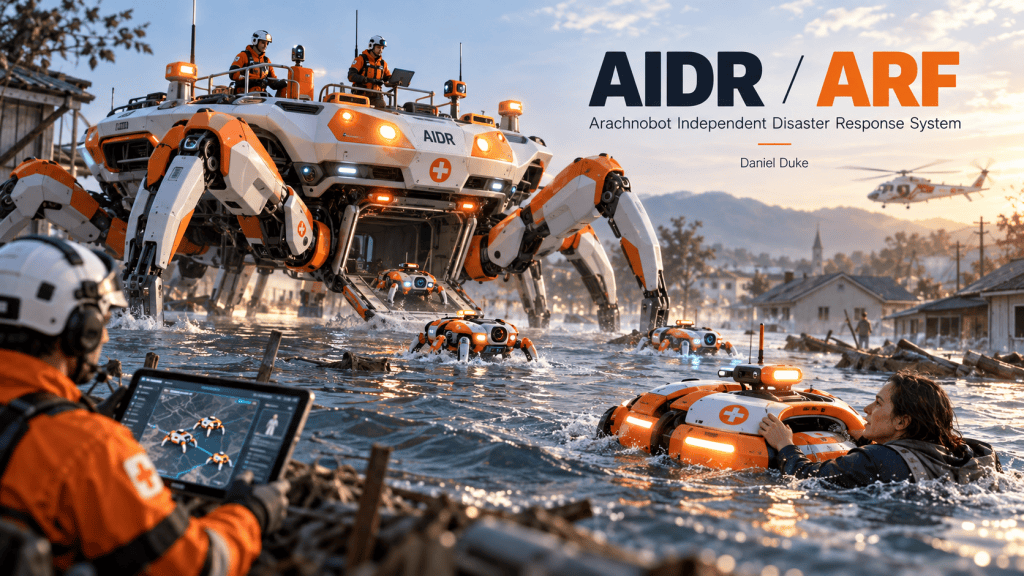
Arachnobot Independent Disaster Response System
with ARF – Autonomous Rescue Flotation
A civilian terrestrial application of Synthetic Organism architecture
“AIDR aids. ARF rescues.”
Concept paper | Version 0.3
Daniel Duke
October 12, 2026
Purpose: peaceful civilian search, rescue, hazard response, and human life safety.
© 2026 Daniel Duke. Licensed under Creative Commons Attribution 4.0 International (CC BY 4.0). Free to share, adapt, and build upon with attribution. See Section 23.
I developed this concept as an open architecture for others to study, improve, test, and build upon. I am releasing it freely under CC BY 4.0 in the hope that someone with the right expertise and resources may find it useful.
| Concept status | This document is an architecture and design concept, not an engineering specification, certification package, medical-device instruction, or field-use procedure. Dimensions, functions, and mission sequences are conceptual starting points for evaluation by robotics, aviation, marine, rescue, medical, human-factors, and public-safety professionals. |
Version 0.3 Revision Note
Version 0.3 formalizes the AIDR family architecture, adds the AIDR Juggernaut heavy rescue platform, and introduces embedded infrastructure response nodes for bridge and roadway emergencies. It preserves the orientation-agnostic mobility, ARF-first development path, bounded autonomy, human oversight, and engineering tradeoffs established in Version 0.2 while extending the system from mobile rescue assets to persistent emergency infrastructure.
| Core design statement | A rollover should be a change in orientation, not a failure state. |
1. Executive Summary
AIDR – the Arachnobot Independent Disaster Response System – is a conceptual family of nested, multi-environment robotic rescue platforms designed to reach people and hazardous locations before or instead of human responders when conditions are too dangerous, inaccessible, unstable, submerged, burning, contaminated, or rapidly changing.
The system applies layered “Synthetic Organism” logic: larger units provide mobility, power, communications, coordination, and shelter for smaller specialist units; smaller units enter spaces the larger units cannot; all remain subordinate to human rescue objectives and incident command.
AIDR is not presented as a replacement for firefighters, rescue divers, search-and-rescue teams, emergency medical personnel, or incident commanders. Its purpose is to extend their reach, reduce blind entry into danger, deliver immediate aid, and return better information to human decision-makers.
Version 0.3 treats the system as a family of mission-specific capabilities rather than assuming every feature must coexist in every machine. If a capability such as integrated VTOL imposes unacceptable mass, endurance, cost, or reliability penalties, the architecture allows that function to move to a carrier or specialized module.
2. Core Design Principles
- Human oversight: AIDR operates in support of human incident command and rescue teams. “Independent” means local resilience when human access or continuous control is temporarily unavailable; it does not mean unconstrained authority.
- Layered response: Large units carry smaller units; smaller units can carry micro-scale “baby” rescue or inspection bots for confined spaces.
- Orientation-agnostic mobility: The platform should remain useful after rollover, impact, debris movement, wind, or water overturning. Which side is “up” should matter as little as practical.
- Multi-environment mobility: Air insertion, rough-terrain walking, self-recovery after rollover, surface flotation, and water mobility are complementary capabilities, but may be distributed across variants if integration compromises safety or endurance.
- Graceful failure: Loss of propulsion, compute, or communications should default toward passive flotation, stopping hazardous movement, preserving victims, and remaining recoverable.
- Rescue before machinery: People, airway, buoyancy, safe access, and clear communication take priority over preserving the robot.
- Modularity: Sensors and rescue tools should be swappable for wildfire, flood, collapse, industrial, or search missions without redesigning the entire platform.
- Peaceful civilian intent: The system is conceived for rescue, inspection, disaster response, and life safety.
3. Why Legs? Orientation-Agnostic Mobility
The strongest rationale for a spider-like form is not appearance. It is recoverability and terrain access. Disaster environments routinely overturn machines: powered landings can go wrong, rubble can shift, floodwater can roll a unit, and falling debris can strike from unpredictable directions. AIDR therefore treats rollover as an expected operating condition rather than an exceptional accident.
A near-symmetrical body with wide-range leg articulation could allow a unit to continue from either primary face, or to reconfigure rapidly without a dedicated self-righting maneuver. The same legs can step over obstacles, bridge gaps, brace against currents, climb out of water, and distribute contact across unstable terrain.
| Mobility approach | Strengths | Limits / design cost |
| Multi-legged (AIDR concept) | Potential orientation independence; step-over capability; multiple contact points; graceful degradation after some leg failures; useful in rubble and irregular terrain. | More actuators, seals, joints, control complexity, mass, cost, and power draw. |
| Tracked | Efficient on many rough surfaces; mature; low ground pressure; can use flippers or self-righting geometry. | Can high-center, foul in debris, or lose mobility at gaps/steps; self-righting usually requires added mechanisms. |
| Wheeled | Simple, fast, energy-efficient, inexpensive on suitable terrain; invertible designs are possible. | Less capable in deep rubble, large discontinuities, roots, steps, and unstable debris. |
| Air-only | Fast access and obstacle bypass. | Payload/endurance/weather constraints; not ideal for sustained close work around people or structures. |
| Boat / surface craft | Excellent water endurance and flotation. | Limited on land, rubble, submerged interiors, and vertical obstacles. |
The paper does not claim that legs are uniquely capable of self-righting. Invertible wheeled robots and tracked robots with flippers already exist. The AIDR hypothesis is that combining orientation tolerance with stepping, bracing, amphibious transition, and nested rescue payloads may justify the additional mechanical complexity in disaster environments.
| Body-wide requirement | True orientation independence affects the entire machine: cameras and ranging sensors need useful coverage from multiple faces; antennas and beacons need protected or redundant placement; propulsion must safely disable or operate regardless of orientation; flotation must establish a predictable surface attitude; and leg joints must tolerate the required motion range without exposing vulnerable mechanisms. |
4. System Family and Formal Class Structure
AIDR is a family of interoperable rescue assets rather than one all-purpose machine. Each class has a defined role, scale, mobility envelope, and place in the chain of human command. Packed dimensions below are conceptual design envelopes, not engineering commitments; actual size should follow payload, energy, propulsion, sealing, structural mass, and mission requirements.
| Class | Packed size / placement | Primary role | Typical mobility / deployment | Carries / supports |
| Juggernaut / Heavy Arachnobot | ~5-6 ft packed body class; vehicle-scale once unfolded | Heavy rescue mobility platform; responder/casualty transport; mobile command and deployment hub | Eight-leg all-terrain travel; stabilized body; sealed flotation and guarded water propulsion; carrier/trailer deployment rather than routine onboard flight | Responders, casualties, Field/Scout units, ARF devices, medical/rescue payloads |
| Field / Mother Arachnobot | ~3-4 ft diameter | Standard local responder and coordination hub | Powered final insertion if mass budget closes; multi-legged ground travel; amphibious operation | Scout Arachnobots, baby bots, rescue tools |
| Scout Arachnobot | ~8-12 in; bowling-ball scale | Confined-area inspection and specialist rescue access | Crawl/swim; short powered repositioning only if practical | Baby bots / micro rescue tools |
| Baby rescue bot | ~3-6 in; softball/grapefruit scale | Tight-space inspection, victim contact, sensing, bounded rescue assistance | Crawl/swim; specialized short-range movement | Small sensors/tools appropriate to mission |
| ARF | Mission-sized flotation device | Rapid delivery of buoyancy and surface support | Carrier/UAS/Arachnobot delivery; passive flotation; guarded water propulsion as designed | Flotation, handles/harness, beacon/comms |
| Sentinel / Infrastructure Node | Fixed hardened bridge/roadway-adjacent compartment or site installation | Persistent hazard detection, traffic protection, dispatch link, and local rescue staging | Fixed installation with deployable barriers, warning units, sensors, and local launch/recovery capability | Search UAVs, ARF, selected Scouts, communications, power, warning systems |
| AIDR Search UAV | Mission-sized; stored at Sentinel nodes, stations, or response vehicles | Rapid visual/thermal search, mapping, relay, and missing-person/vehicle localization | Autonomous search patterns under dispatcher/incident-command supervision | Sensors, lights, comms relay, optional approved rescue payloads |
4.1 Formal Role Structure
The class structure follows a simple rule: use the smallest asset that can safely accomplish the mission. Juggernaut moves people and heavy capability through terrain that defeats ordinary vehicles; Field/Mother coordinates local response; Scouts enter confined areas; baby bots perform close inspection or bounded rescue assistance; ARF delivers flotation; Sentinel nodes provide persistent infrastructure readiness; Search UAVs provide rapid aerial situational awareness. No class is required to carry every capability, and human incident command remains above the system.
5. Engineering Closure: Mass, Power, Endurance, and Modularity
The all-in-one concept is attractive, but integration is the central engineering risk. Legs add actuator mass; sealing adds structure and friction; VTOL requires high peak power; water propulsion adds another drivetrain; payload bays compete with batteries and buoyancy volume. Version 0.3 therefore defines a design-budget framework rather than assuming all functions will fit.
| Constraint | Version 0.3 design stance | Early validation question |
| Powered insertion | Optimize for final descent, wind correction, obstacle avoidance, and short repositioning – not long-range independent flight. | Can lift/propulsion hardware justify its mass after carrier transport already handles long range? |
| Ground endurance | Prioritize useful on-scene sensing and locomotion duration over aerial endurance. Battery swap/recharge should be possible at the Mother/Titan or staging area. | Does the leg system deliver enough mission time after actuator and sealing losses? |
| Water operation | Passive flotation must not depend on power. Active water propulsion is for local approach, station keeping, and recovery rather than long-range boating. | Does the unit remain stable and recoverable with propulsion disabled? |
| Nested payload | Carry only the number/type of Scouts, baby bots, ARF devices, and rescue tools justified by the mission. | Does payload reduce mobility or endurance below mission thresholds? |
| Sealing / thermal protection | Treat water, smoke, heat, dust, and contamination protection as first-order design drivers, not add-ons. | Can joints, bearings, batteries, and sensors survive representative environments? |
| Architecture escape hatch | If integrated VTOL or amphibious hardware makes the core robot impractical, move that function to a carrier, detachable module, or mission-specific variant. | Is one combined platform actually safer and cheaper than a coordinated set of simpler platforms? |
| Engineering gate | Before any full-scale prototype, close a first-pass mass and energy budget: structure + legs/actuators + energy storage + powered insertion + flotation/sealing + sensors/compute/comms + payload + reserve. A feature remains in the integrated design only if the budget still supports useful rescue endurance and controllability. |
6. ARF as a Near-Term Entry Point
ARF – Autonomous Rescue Flotation – is the lowest-complexity, most independently testable part of the AIDR family. It should be developed as a useful passive flotation device first, then as a remotely or autonomously delivered device, and only later as one component of the full AIDR ecosystem.
Robotic and drone-delivered flotation already has important prior art. The Office of Naval Research-supported EMILY system is a remote-controlled robotic lifeguard buoy used for water rescue and disaster response. Public-safety agencies also deploy UAS-carried inflatable flotation devices; in 2026 the Broward Sheriff’s Office described drones carrying Restube devices that inflate after being dropped to swimmers in distress. These precedents demonstrate that rapid robotic flotation delivery is practical and useful, while also making clear that ARF should not be presented as the first robotic lifeguard or first drone-delivered float. [1][2]
The AIDR/ARF contribution is therefore the proposed integration: flotation as one passive-safe subsystem within a broader nested rescue architecture, capable of handoff among carrier, Mother, Scout, and human responders.
| ARF principle | Requirement |
| Primary purpose | Deliver immediate buoyancy to a person in floodwater, open water, or post-extraction conditions. |
| Passive first | If electronics, propulsion, or communications fail, ARF must still remain useful as flotation. |
| Delivery | Carrier UAV, Arachnobot, responder-thrown, or other approved method; no dependency on a single delivery platform. |
| Water behavior | Guarded propulsion may allow approach or station keeping, but propulsion must not create a hazard to a person grabbing the device. |
| Human interface | Large obvious grab points, high-visibility form, simple cues, and support geometry suited to exhausted or panicked users. |
| Child use | Child-appropriate sizing or adjustment; do not assume a young child can correctly don conventional rescue equipment under stress. |
7. Three-Mode Arachnobot
The standard Field/Mother Arachnobot is conceived around three operating states. The transitions between them are as important as any single mode.
7.1 Transport / Folded Mode
Legs, propulsion elements, sensors, and vulnerable tools fold into or around a compact central body for storage in aircraft, vehicles, trailers, or larger AIDR carriers. The central core should be sealed and rugged, with protected sensors, low idle power, self-test capability, and quick-release deployment interfaces.
7.2 Powered Final Insertion / VTOL Mode
The concept favors protected powered lift or another VTOL approach for controlled final descent, wind correction, obstacle avoidance, brief hover, and precise placement. Long-distance carriage remains the job of a larger UAV, aircraft, or ground vehicle. This distinction limits the aerial energy burden on the Arachnobot itself.
If the mass/power trade proves unfavorable, powered insertion may be provided by a detachable delivery frame, carrier-controlled lowering system, or mission-specific variant rather than forced into every Arachnobot.
7.3 Ground / Amphibious Response Mode
After landing, multi-legged locomotion allows the robot to step over logs, rubble, roots, ditches, structural debris, and irregular surfaces. A near-symmetrical body and wide-range leg articulation support orientation recovery. In deep water, sealed flotation and guarded water propulsion allow the unit to remain useful; legs can assist with bracing, shallow-bottom movement, climbing out, and transitions between water and land.
7.4 AIDR Juggernaut – Heavy Rescue Mobility Platform
The AIDR Juggernaut is the heavy mobile class: a man-ridable, casualty-carrying, amphibious rescue platform intended for situations in which roads are gone, conventional vehicles cannot safely proceed, or responders need a stable moving base across rubble, mud, floodwater, ice, washed-out surfaces, or mixed terrain.
The Juggernaut is not simply a larger Mother Arachnobot. Its primary payload is people, heavy rescue equipment, communications, power, and smaller AIDR units. A low, broad body and independently controlled legs would use terrain preview and active stabilization to keep the responder/casualty deck as level and smooth as practical while the legs absorb local terrain changes.
A sealed buoyant body and guarded water propulsion would allow a loss of footing to become a transition to flotation rather than a catastrophic event. Legs could assist with bracing in current, shallow-bottom movement, shoreline exit, mud traction, and deliberate foot placement on ice or unstable debris. Mission-specific feet or pads may be required for mud, ice, rock, or structural rubble.
Vehicle scale changes the aerial trade. Routine onboard VTOL is not assumed for the Juggernaut; trailer, truck, aircraft, heavy-lift carrier, or pre-positioned deployment is more credible unless a future mass/power budget supports powered placement. The design goal is not to guarantee passage through every environment, but to reduce the number of emergencies in which loss of a usable road becomes loss of rescue access.
Passenger safety is a first-order requirement: restrained seating or casualty litter mounts, protected egress, crush/leg clearance zones, emergency stop and manual override, conservative speed around people, redundant braking/stance control, and a safe degraded mode after partial actuator or sensor failure.
| Juggernaut design intent | Do not ask whether the road is passable. Ask whether a safe path for rescue still exists. | |
| Mobility philosophy | Do not make loss of the preferred environment a mission-ending event. Land, water, rollover, rubble, and aerial insertion should trigger a mode change or graceful fallback rather than an automatic rescue failure. | |
8. Nested Response: Mother, Scouts, and Babies
The nested architecture is one of AIDR’s defining features. The larger unit remains in the most stable position available and sends smaller units into spaces where size, risk, geometry, or access make entry by the Mother impractical.
- Mother Arachnobot: power, local compute, mapping, communications, lighting, payload storage, flotation, recharge, and coordination.
- Scout Arachnobots: smaller mobile specialists that can enter vehicles, structures, narrow passages, water, or debris fields while retaining more capability than micro-bots.
- Baby rescue bots: compact units for very tight inspection, victim contact, localized sensing, emergency delivery, or carefully bounded rescue assistance.
- Role specialization: not every baby carries every tool. A mixed population can include camera/sonar scouts, environmental sensors, guidance lights, communication units, or rescue-assist tools.
The word “baby” is retained as an informal working term because it makes the nested relationship intuitive. A future engineering program may assign formal class names once payloads and dimensions stabilize.
9. Submerged Vehicle and Flood Rescue Concept
A submerged or partially submerged vehicle illustrates both the value and the limits of the nested design. Version 0.3 separates near-term reconnaissance from advanced intervention so the concept does not imply that a 3-6 inch bot can immediately perform complete underwater extrication.
9.1 Near-Term Reconnaissance and Victim Contact
- Mother reaches the vehicle or structure, floats or anchors in the safest practical position, maps the scene, and establishes communications with incident command.
- A water-capable Scout or baby unit descends to inspect the vehicle, identify apparent occupants, assess access points, and map nearby hazards.
- If a conscious occupant is found, the unit uses high-visibility light, audio, display, or another simple interface to identify itself as rescue equipment and reduce confusion.
- The system relays occupant position, apparent condition, window/door access, water level, and local geometry to human rescuers.
- Where appropriate, the unit can place a light, marker, guide line, or communication aid while awaiting the next authorized action.
9.2 Advanced Rescue-Assist Research
The following capabilities are research goals, not assumed near-term functions. They should be developed only with rescue divers, emergency medicine, pediatric safety, automotive-glass specialists, human-factors engineers, and relevant authorities.
| Advanced function | Concept | Primary hazard to resolve |
| Emergency breathing aid | Deliver a compact breathing interface to a conscious trapped occupant when professionally validated. | Misuse, panic, fit, compressed-gas physiology, ascent behavior, training, and medical contraindications. |
| Mechanical access | Use a localized mechanical glass punch/cutter or other approved rescue tool after verifying occupant position and exit geometry. | Different glass constructions; fragmentation; sudden water equalization/flooding; entanglement; vehicle instability. |
| Buoyancy support | Position a broad upper-torso/underarm flotation harness rather than applying concentrated force to the neck. | Fit across body sizes, unconscious-person support, inflation in confined spaces, entanglement, ascent control, pediatric differences. |
| Guided exit / ascent | Guide or support movement toward the safest exit and surface handoff. | Obstacles, currents, rapid ascent, disorientation, compressed-gas use, medical status. |
| Design rule | Inspect first. Communicate second. Intervene only when the action has been validated, the path is understood, and human authority or an approved protocol permits it. |
10. Autonomy Boundaries and Human Authority
The word “Independent” describes resilience, not decision-making sovereignty. AIDR needs explicit action classes so degraded communications do not accidentally authorize irreversible rescue actions.
| Operating state | Actions AIDR may perform | Actions it should not initiate |
| No reliable link | Stabilize itself; avoid collisions; stop dangerous motion; maintain passive flotation; continue non-contact sensing; preserve last safe position; beacon/log; attempt safe relay or return; keep supporting a person already holding ARF. | New breaching, compressed-gas delivery, harness inflation/attachment, forceful physical manipulation, or other irreversible victim-facing action unless a future validated protocol explicitly preauthorizes it. |
| Live human supervision | Navigate within assigned area; deploy/recover Scouts in non-contact tasks; map; inspect; communicate with victims; deliver ARF or noninvasive aid under supervision. | Actions beyond operator authority or outside the incident action plan. |
| Explicit human authorization | Execute validated victim-contact actions such as approved mechanical access or advanced rescue-assist steps when conditions and specialist protocols are satisfied. | Improvisation outside validated tools, force limits, and approved rescue procedures. |
Human incident commanders retain mission authority. Where communications permit, they can redirect, pause, recall, isolate, or terminate unit actions. If an agency later authorizes narrow automatic interventions, those should be defined as explicit preapproved rescue protocols rather than open-ended machine discretion.
11. Human Factors, Appearance, and Trust
A mechanically optimal rescue robot can still fail if a frightened child, injured adult, or panicked swimmer sees it as threatening. The spider-like geometry therefore creates a human-factors obligation as important as the locomotion benefit.
- Use high-visibility rescue markings and non-tactical visual design.
- Approach people slowly and predictably; reduce sudden leg or propulsion movements near victims.
- Provide simple identification such as “Rescue robot – I am here to help” using light, audio, display, or symbol systems suited to noise and language limitations.
- Use soft or guarded human-contact surfaces and eliminate exposed pinch points and propulsion hazards near grasp areas.
- Provide child-appropriate cues and test reactions with diverse users before field deployment.
- Design privacy and evidence handling for cameras entering homes, vehicles, medical scenes, and other sensitive spaces.
12. Representative Civilian Mission Profiles
Wildfire
Thermal mapping, hotspot and ember detection, rough-terrain reconnaissance, communications relay, sensor placement, and nighttime monitoring while reducing unnecessary human exposure. AIDR aerial operations must be integrated with incident aviation management rather than flown independently around firefighting aircraft.
Flood / hurricane
Enter flooded neighborhoods; navigate surface water and debris; inspect vehicles/buildings; locate occupants; deploy ARF; relay real-time maps and observations to human responders.
Earthquake / structural collapse
Traverse rubble; map voids; place small Scouts into spaces too tight or unstable for people; locate survivors; monitor structural/environmental conditions; help responders choose safer access routes.
Industrial / hazardous environment
Inspect heat, smoke, gas, chemical, radiological, or structural hazards where direct human entry is initially unsafe; maintain remote situational awareness until specialized teams can act.
Remote search and rescue
Reach canyons, forest, storm debris, washed-out roads, or other inaccessible terrain by carrier platform and controlled final insertion; deploy Scouts and flotation/rescue aids as required.
Wildfire airspace note
Wildfire airspace is highly coordinated. FAA Temporary Flight Restrictions can prohibit unauthorized drone operations around fires, while authorized public-safety UAS may operate through emergency approval and fire-aviation coordination. NIFC/NWCG guidance similarly treats UAS as an aviation resource requiring coordinated risk management. AIDR therefore must integrate with the controlling agency and air-operations structure; independent launch into active fire airspace is not an acceptable operating model. [3][4]
13. Communications and Degraded-Environment Operation
AIDR should not assume continuous high-bandwidth connectivity. Smoke, structures, terrain, water, damaged infrastructure, congestion, and radio interference can reduce link quality.
- Use the Mother/Titan as a local relay and data concentrator when practical.
- Allow Scouts to store-and-forward maps and sensor data when links are intermittent.
- Support multiple communications paths where mission and regulation permit rather than one single point of failure.
- Keep no-link behaviors conservative and aligned with the autonomy table in Section 10.
- For submerged units, treat underwater communications as a distinct engineering problem; tethers, acoustic links, or short-range methods may be preferable depending on geometry and mission.
- Log mission data locally so temporary link loss does not erase the event record.
14. Power, Battery, Materials, and Environmental Safety
AIDR is intended to work in the exact environments that are hostile to batteries, seals, actuators, and electronics. Energy architecture cannot be treated as a generic drone battery choice.
- Battery chemistry, enclosure, isolation, venting, charging, and replacement strategy must be evaluated specifically for heat, impact, smoke, contamination, and water exposure.
- Battery modules should be physically isolated from victim-contact surfaces and flotation volumes where practical.
- Loss of electrical power must not eliminate basic buoyancy in water.
- Heat-sensitive components should be shielded or kept away from direct flame exposure; wildfire missions may require standoff sensing rather than physical entry into extreme heat.
- Contaminated missions require materials and seals compatible with decontamination or cost-effective disposal.
- Actuators should support graceful degradation: a multi-legged unit should retain limited mobility after one or more leg/joint failures where mechanically feasible.
15. Incident Command Integration
AIDR should enter public safety as a resource inside existing command structures, not as a parallel autonomous authority. FEMA’s National Incident Management System and Incident Command System provide a common hierarchy, terminology, and processes for coordinating personnel, equipment, communications, and tactical objectives across agencies. [5]
- Incident Commander or Unified Command sets objectives and priorities.
- Operations assigns AIDR missions; Planning incorporates robot-derived maps and observations; Logistics manages charging, batteries, payloads, transport, retrieval, and repair.
- Aviation-capable AIDR assets coordinate through the appropriate air operations / UAS structure.
- Robot status, tasking, geolocation, hazards, and handoff should be visible in the same operational picture used by responders rather than isolated in a vendor-only interface.
- After-action records should support review of human commands, autonomy decisions, sensor confidence, failures, and victim-facing actions.
15.1 Embedded Infrastructure Response Nodes
AIDR can also exist as infrastructure rather than as a vehicle dispatched from elsewhere. A bridge, low-water crossing, flood-prone roadway, tunnel, or other known hazard point could include a hardened Sentinel compartment with independent power, communications, sensors, warning devices, deployable barriers, and selected rescue assets maintained on standby.
| Infrastructure principle | The first responder to a disaster does not always have to be a person. Sometimes the first responder could be the bridge itself. |
A Sentinel node should favor prevention of secondary casualties before complex rescue. A validated bridge-failure, washout, or roadway-loss event could trigger high-intensity warning lights and immediate dispatch notification; where authorized and technically justified, the node could also deploy physical lane-blocking devices so approaching drivers encounter an unmistakable barrier before reaching the hazard.
Activation should use sensor fusion and conservative fail-safe logic appropriate to the site. The system must distinguish between an urgent warning state, a confirmed road-closure state, and rescue/search activation so false alarms do not create new hazards while real failures are not left waiting for a human to discover them.
15.2 Dispatch, Search UAVs, and Missing-Person Coordination
When a bridge or roadway failure is detected, dispatch should receive an immediate alert, site status, and live camera/sensor feed where communications permit. The objective is to let dispatch and incident command begin understanding the event while human units are still en route.
- If sensors indicate that a vehicle left the roadway or entered water, standby Search UAVs can launch into preplanned upstream/downstream search sectors under established public-safety procedures.
- If a caller later reports a person missing near the site, dispatch can redirect or expand the search, assign priority areas, and request a drone hold over a suspected target rather than manually flying every aircraft.
- Search UAVs can provide visual/thermal observation where effective, shoreline and debris-field mapping, current-direction context, and live geolocation for responders; confidence limits should remain visible to operators.
- If a viable rescue opportunity is identified, ARF, Scouts, Field units, or other approved AIDR assets can be tasked by incident command according to the autonomy and authorization boundaries in Section 10.
- The node should preserve event timing, sensor data, search tracks, commands, and handoffs for responder situational awareness and later after-action review.
The operational aim is simple: convert the time between infrastructure failure and responder arrival from an information vacuum into an active warning, search, and coordination interval.
16. Retrieval, Decontamination, and Logistics
- Every deployable unit should carry a recoverability plan: location beacon/log, last-known position, visual identifier, and retrieval method appropriate to the mission.
- Small Scouts and baby bots may be treated as recoverable or deliberately expendable depending on contamination, structural entrapment, and cost – but the choice should be explicit.
- Flood, sewage, industrial, chemical, smoke, and biological exposure require mission-specific decontamination procedures before reuse.
- Modular batteries, sensors, propulsion modules, legs, and tool packs should reduce turnaround time and simplify inspection.
- Post-mission inspection should identify water ingress, thermal damage, joint contamination, impact damage, and sensor drift before redeployment.
17. Test Methods, Metrics, and Success Criteria
The AIDR program should not invent its own definition of “works.” NIST has developed more than 50 response-robot test methods across ground, aerial, and aquatic systems, including mobility, sensing, endurance, communications, autonomy, logistics, durability, and safety, with many standardized through ASTM E54.09. These provide an appropriate starting benchmark for AIDR development and responder evaluation. [6][7]
| Metric family | Example AIDR measure |
| Deployment | Time from carrier/staging state to stable mission-ready state. |
| Orientation recovery | Probability and time to resume useful movement after controlled flips/rollovers across representative terrains. |
| Mobility | Obstacle, gap, stair, gravel, rubble, slope, wet-surface, and land-water transition performance. |
| Sensing | Victim/target detection and localization accuracy under smoke, darkness, opaque water, clutter, and glare. |
| Communications | Range, non-line-of-sight availability, degraded-link behavior, data recovery after interruption. |
| Endurance | Mission time by operating mode and payload; battery swap/recharge turnaround. |
| ARF | Delivery/approach accuracy, passive buoyancy, grab accessibility, stability with electronics disabled, human-factor success. |
| Nested deployment | Scout/baby deployment and recovery reliability; time to reach confined target; tether/fouling performance if used. |
| Fail-safe | Demonstrated safe state after power, link, sensor, actuator, propulsion, and partial leg failures. |
| Human factors | Responder workload, victim comprehension, approach acceptance, child/adult interaction, training burden. |
18. Practical Development Path
AIDR does not require every capability to exist in the first prototype. A credible program should retire risk in stages while keeping humans out of experimental hazard zones.
| Stage | Objective | Exit criterion |
| 1 – ARF passive/assisted prototype | Start with certified-rescue-device thinking: buoyancy, grab geometry, passive-safe behavior, remote delivery concept, and human factors. | Useful flotation remains safe with electronics disabled; delivery trials show benefit without adding victim hazard. |
| 2 – Orientation-agnostic mobility | Build multi-legged ground demonstrator with teleoperation, controlled rollover recovery, and damaged-leg testing. | Repeatable mobility and recovery on NIST/ASTM-style terrains; graceful degradation demonstrated. |
| 3 – Sensing / command integration | Add thermal/visual/depth sensing, local mapping, conservative autonomy, ICS-compatible operator interface, and fail-safe behaviors. | Responders can task, supervise, understand, and stop the system with acceptable workload. |
| 4 – Amphibious demonstrator | Add sealed flotation, guarded water movement, land-water transition, and recovery. | Passive buoyancy and controlled water/shore transition demonstrated under representative conditions. |
| 5 – Powered final insertion | Test protected powered descent or detachable insertion module after mass/power budget is known. | Precise placement improves mission access without unacceptable endurance, safety, or payload penalty. |
| 6 – Nested Scouts | Deploy/recover smaller units for rubble, confined-space, and underwater reconnaissance. | Reliable launch, communication, localization, and recovery in representative spaces. |
| 7 – Advanced rescue-assist modules | Develop breathing, mechanical-access, harness, and guided-exit functions only with qualified specialists. | Each intervention independently validated for the intended victim/environment before integration. |
| 8 – Integrated field exercises | Run controlled exercises with public-safety agencies and existing incident-command structures. | Quantitative performance, responder acceptance, safety review, and after-action findings support limited operational pilots. |
19. Cost and Procurement Logic
Version 0.3 does not assign speculative dollar figures. Cost should be derived from prototype bills of material, maintenance burden, training, battery logistics, payloads, replacement rates, and mission value. The architecture should be challenged against simpler alternatives at every stage.
- If a simple drone plus ARF solves a water-rescue mission, do not deploy a Mother Arachnobot merely because it exists.
- If a tracked robot outperforms legs for a specific industrial inspection, use the tracked robot.
- Reserve the integrated Arachnobot for missions where orientation recovery, obstacle traversal, water transition, nested deployment, or multi-role coordination materially changes the outcome.
- Cost-effectiveness should include avoided responder exposure, faster situational awareness, reusable payloads, and reduced need for multiple separate specialized platforms – but these benefits must be measured rather than assumed.
20. Relationship to Synthetic Organism Architecture
AIDR is conceived as a terrestrial civilian application of the same systems philosophy explored in the Synthetic Organism Deep-Space Architecture. Both use nested units, local intelligence, redundancy, modular roles, and graceful degradation. Their missions are different: the deep-space architecture focuses on long-duration exploration and infrastructure; AIDR focuses on immediate human life safety and disaster response.
The shared idea is simple: a complex environment should not depend on one machine doing everything. A coordinated family of machines can distribute risk, specialize by scale, and continue useful work when a larger unit cannot physically reach the problem.
21. Working Terminology
| Term | Working meaning |
| AIDR | Arachnobot Independent Disaster Response System; the overall civilian rescue architecture. |
| Arachnobot | Multi-legged rescue platform designed for rough terrain, orientation recovery, and multi-environment operation. |
| Mother / Field Arachnobot | Standard local hub that carries tools, communications, Scouts, and baby bots. |
| Scout Arachnobot | Smaller specialist unit for vehicle, structure, water, or confined-area access. |
| Baby bot | Informal term for micro-scale rescue/inspection unit deployed where size and access dominate. |
| ARF | Autonomous Rescue Flotation; a self-delivered or robot-delivered flotation subsystem designed to remain useful as passive flotation after power loss. |
| Synthetic Organism | Broader architectural philosophy of nested, cooperative, resilient machines functioning as an integrated system. |
| Juggernaut | Heavy, man-ridable AIDR Arachnobot class for responder/casualty transport, heavy payloads, amphibious all-terrain access, and deployment of smaller AIDR assets. |
| Sentinel / Infrastructure Node | Fixed or semi-fixed AIDR installation at a bridge, roadway, crossing, or other hazard point that can detect failures, warn/block traffic, alert dispatch, and stage rescue/search assets. |
| AIDR Search UAV | Aerial search/relay asset stored at Sentinel nodes or response bases and tasked by dispatch or incident command for rapid mapping and missing-person/vehicle localization. |
22. Selected Prior Art, Standards, and Operational References
These references are included to position AIDR against existing rescue technology and established public-safety practices. They do not constitute a complete prior-art or patent search.
[1] U.S. Navy / Office of Naval Research. From Whales to Silver Foxes to Refugees: EMILY Robot is A Lifesaver. https://www.navy.mil/Press-Office/News-Stories/display-news/Article/2261014/from-whales-to-silver-foxes-to-refugees-emily-robot-is-a-lifesaver/ Documents EMILY as a remote-controlled robotic lifeguard buoy developed with ONR support.
[2] Broward Sheriff’s Office. Help From Above: BSO Has New Tool to Help Swimmers in Distress. https://www.sheriff.org/pio/breaking-news/help-from-above-bso-has-new-tool-to-help-swimmers-in-distress/ Describes 2026 UAS delivery of automatically inflating Restube flotation devices.
[3] Federal Aviation Administration. Temporary Flight Restrictions (TFRs). https://www.faa.gov/uas/getting_started/temporary_flight_restrictions Explains wildfire/disaster TFRs and emergency public-safety authorization.
[4] National Interagency Fire Center. Interagency UAS Program / Wildland Fire UAS. https://uas.nifc.gov/ Provides current interagency wildfire UAS coordination, standards, and operational guidance.
[5] U.S. Fire Administration / FEMA. NIMS Can Help: Command and Coordination. https://www.usfa.fema.gov/a-z/nims/command-and-coordination.html Summarizes NIMS command/coordination and ICS integration.
[6] National Institute of Standards and Technology. Performance of Emergency Response Robots. https://www.nist.gov/programs-projects/performance-emergency-response-robots Describes response-robot measurement science and ground/aerial/aquatic test categories.
[7] National Institute of Standards and Technology. Standard Test Methods for Response Robots. https://www.nist.gov/el/intelligent-systems-division-73500/standard-test-methods-response-robots Links NIST response-robot capability testing to ASTM E54.09 standards work.
23. Purpose, Publication, and Release Intent
This concept is presented for peaceful civilian search and rescue, firefighting support, flood response, structural-collapse response, hazardous-environment inspection, humanitarian disaster response, and related life-safety research. It is intended to help capable engineers, researchers, public-safety professionals, and organizations evaluate whether the architecture can be improved, tested, and ultimately used to save lives.
| Design intent | AIDR does not replace rescuers. It extends their reach. |
Prior-art and novelty note: individual capabilities described here – including response robots, robotic flotation, drone delivery of flotation, legged locomotion, self-righting systems, UAS wildfire operations, and nested robotics – have existing precedents. This paper proposes an integrated civilian rescue architecture and should not be read as a claim that each component or capability is novel.
License and reuse: © 2026 Daniel Duke. This work is licensed under Creative Commons Attribution 4.0 International (CC BY 4.0). Readers may share and adapt the work, including building upon it, provided appropriate attribution is given. The license applies to the published paper and its expression; it does not itself certify technical safety, regulatory approval, medical suitability, or operational readiness.
AIDR aids. ARF rescues.
Study it. Improve it. Test it. Use it to save lives.






Leave a Reply